Showing posts with label compost. Show all posts

Monday, November 14, 2011

Sheet mulching and pH

Finally we have our first two beds filled with dirt.
The first one we sheet mulched in order to build the soil directly into the bed and the other we 
simply filled with cenote dirt.
I used sheet mulching a lot in our garden in NC, when opening another piece of grass up for growing, rather than digging out the grass, I would simply cut it real short and sheet mulch directly on top of the grass. This would incorporate the grass, roots and all the layers into the building of the soil, and at the same time avoid disturbing all the life beneath the grass.
Here however I am trying out using this technic to build the soil directly into the raised bed.
This is the process we used this time around, every time I have sheet mulched it is always a little different, depending on the materials I have on hand.

First we cleared out all the rocks, well the ones that we physically could.
 Then to clean the soil (as has been suggested by local farmers) we added a layer of ashes and left it in the sun for a day. (as it turns out I wonder if this was a good idea as my soil test proved that our soil, at least the cenote dirt, is very alkaline, and ashes are used to make acid soil more alkaline, so not exactly what we needed) .... ohh well....
 Then we added a layer of card board, if there are any weeds or if you are sheet mulching on top of grass or thick weeds this layer will smother it. Then lots of water.
 Then we added a thick layer of greens
 Then lots of water, as between each layer, in essence much like making a compost pile.
 Then we added a layer of dry matter, could be leaves, newspapers, or what ever you have, we used 
the dried cut grasses from the cenote. Then more water.
 Then a layer of horse manure, and more water.
 Then we added a layer of our ready compost, then more water.
 And finally a layer of cenote dirt.
Ideally I would leave that for a few months, in NC I would leave it to overwinter and it would be ready in spring, but here with the heat I think it will soon be ready, because it has already been sitting for about   4-5 weeks and is no longer warm at all.
Now the bed below is filled with just cenote dirt.
I did a home soil test the other day and it tested the soil very alkaline, which usually translates into a high salt content, this makes sense as the dirt is taken from the cenote. Apparently at some point the saltwater of the sea mixes a little with the underground river systems here, so sometimes the water is more salty than others. Also we find alkaline soil mostly in arid areas, which this place must be said to be, at least somewhat, when we arrived in early summer, it was just the end of 
dry season and it looked much like a dessert everywhere. 
Apparently it is tougher to lower the pH of the soil than it is to raise it if your soil is too acid. Generally soil is considered neutral when the pH measures 7.0, anything below is considered acid soil anything above is considered alkaline. Most plants prefer a pH around 6.5-7.0.
Our cenote soil measured at least 7.5, that may not seem like much but it makes nutrients in the soil unavailable to the plants and encourages pests and sickness in plants when the pH is off.

There are a few ideas out there as to how to remedy this problem.
Add plenty of organic matter, when we have more compost ready I will mix at least half the bed
with compost. Adding peat is also mentioned, but peat is expensive, a nonrenewable resource and I do not even know if we can get it here. Another suggestion is adding sulfur straight to the soil, not sure about that but does not sound like a sustainable way to handle the problem. You might also add vinegar, which has a very low pH, but this will need to be done continuously to work, and so not very practical.
Another suggestion mentions composted sawdust, this we have though not composted, 
and I will add some once it has broken down a bit. 
Horse manure is also said to do good and this we are already adding.
I hope and believe that adding plenty of compost, growing a cover crop rich in nitrogen and continually adding mulches will go along way to solve the problem, but I will keep you posted on the progress.
Can you tell these things interest me? I find the workings of the soil so interesting.
~Blessings~

Friday, October 14, 2011

Around the Land, and thinking of a home


We built a nice communal dining table, it is a rustic replica of our 
dining room table in North Carolina, built cheaply out of a neighbors scrap wood.

Lots of composting going on, we are struggling a bit with the shade over the piles, but otherwise they are cooking nicely, ready to be turned beginning of next week. I think that we will build a more permanent composting structure in the near future, there are many pallets laying around everywhere in town, and I thought we might make a row of several separate spaces to keep the piles contained, with an empty space next to each to turn the pile over into. Also a more permanent shade structure is in the plans.

 28 sour orange tree saplings were also transplanted into bags so they can receive a bit more attention until they and the landscaping is ready to have them planted into their permanent spot.
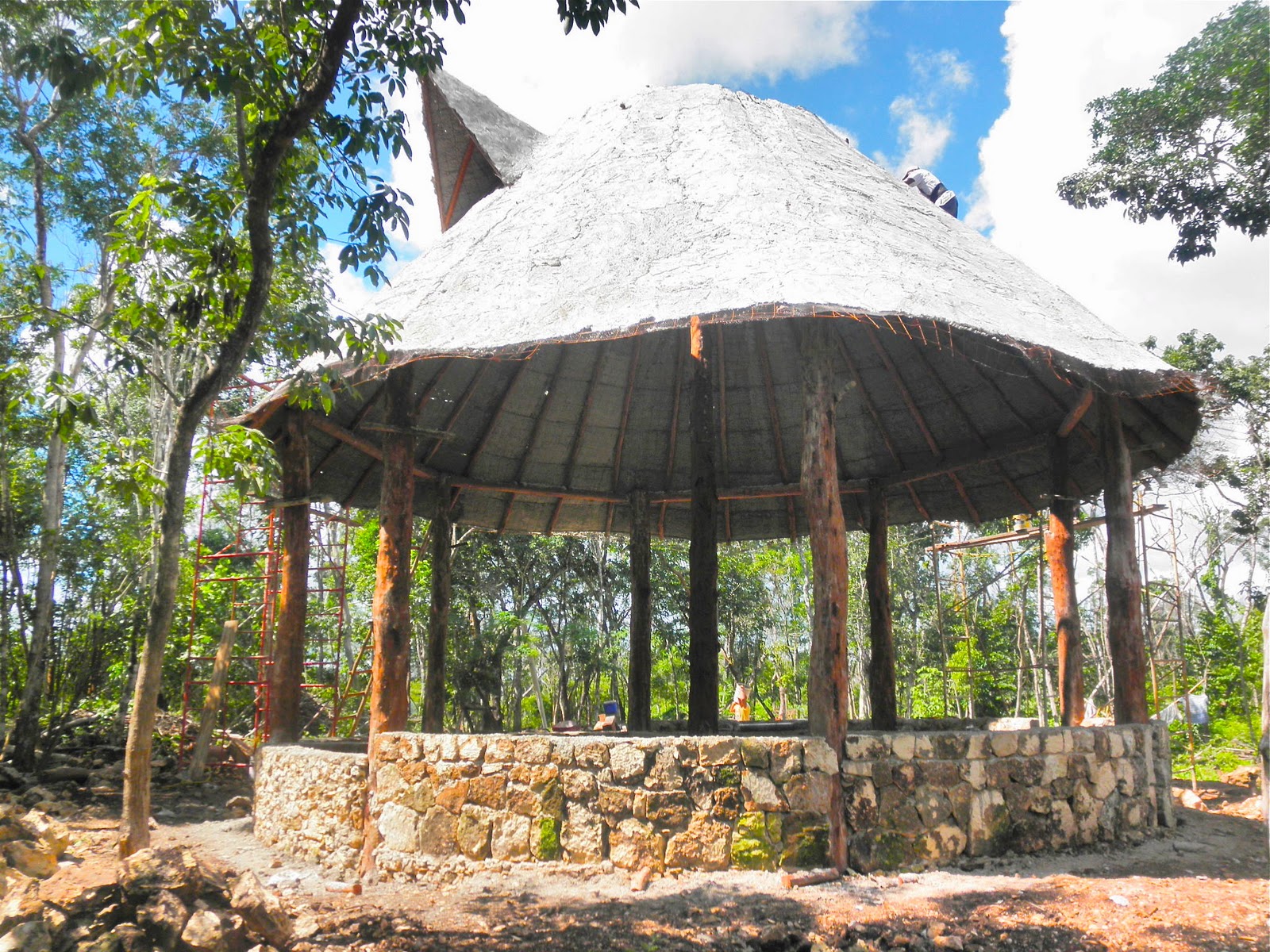
In the back by the animals, the "mayan hotel"
(this name was given to the structure by the crew that currently lives here)
 is almost complete, this structure will house a workshop, storage and tool shed, as well as kitchen and sleeping area for the couple of helpers that will live on the land permanently.
The house where we will live is moving along also, the roof is almost complete, although when looking at a photo from a couple of weeks ago, you might not notice a difference because they have simply been adding layer after layer for the thickness. 
There has been a lot of unrest about the fact that the first house built 
on the land is to house our family, because as a fact we are not partners in this project.
With many people involved, many far away, working together on a project such 
as this it seems inevitable that some conflicts will arise in terms of interests.

I will be honest and say that it has been tough standing in the middle of this, feeling the emotions pulled first in this direction and then in that. I feel at moments very uncertain about our place in it all, will the work we do be enough to satisfy all the partners, will the value we bring be tangible enough for everyone to feel peaceful and right about this structure becoming our home while we work this land?
When we were asked to come, it was with the understanding that we would have a private place where we could settle in, a home, for the time that we are here.
Now however due to cost  and conflictive interests the upstairs is to be used as a separate studio, where the partners can come and stay until another structure is completed.
To be honest, I think that this is fair and right, they have all spent a lot of money and still have no place to stay when they come. What concerns us a bit is,
will this be a temporary situation or will we in effect be living in a hotel,
with people coming and going, while we feel much like guests.
As we see it, the solution would be to keep the upstairs as part of our home, with the understanding that until another structure is completed any partner is a welcome guest and will indeed have the upstairs for them when they visit. An outside entrance to the loft would be added,
60-70% of the space upstairs would be divided off as a guest room
with private bathroom to be available for the partners to use, yet still to remain part of the house.
With such a solution, the interest of the partners is accommodated,
(after all it is not often that they come down here) and our initial agreement honored.
We understand that no one owes us anything nor do we have the right to
ask for much, all we can do is pray that what turns out to be the best for everyone involved is for us to have a home, a place where our family can settle for the time being, and therefor do our very best work.


~Blessings~

Friday, October 7, 2011

This day

These days whenever I go to the land, I always make a few stops along the less trafficked roads to pick up greens for my compost piles. I make a new pile most days I go lately, and right now there are 5 piles cooking,  getting ready, rich good compost for the vegetables beds.
I really enjoy this process, getting the pile just right, each time getting it more the way I want it; nice and square to keep even pressure throughout the pile, thoroughly wet between each layer. Then checking the temperature by sticking a machete into the center and see how hot it comes out and then some more to aerate it, adding more water if too dry and so on. 
Building the soil, giving love and intention to the earth that will later grow the food that will nourish us, 
I love it! 

 The compost is cooking, the seeds have sprouted all we need now are the beds ready.
Today Miguel and I cleared the first bed of many many rocks, 
while Abelardo filled a few of the remaining holes in the walls. Then I added a dusting of ashes to add some potassium, but more as a kind of cleanser for the soil. 
This was recommended by a local gardener, to give a fresh start.
Saturday I will sheet mulch inside the bed to build the soil right where we need it, I think that in this heat, if we keep it wet and aerated it should be ready to plant within a month.


 The crocodile was around again, but I was too late with the camera and caught just the tail 
slipping into the water


 I checked on all the babies, we have many trees sprouting nicely. Especially the avocado
seeds have almost all shot up nice little trees. And when we were cleaning an area the other day I started many cuttings from the trees to see what would root, and so far it looks like they all are rooting nicely.
And of course I stopped by the house a few times, it is coming along nicely...
~Blessings~

Tuesday, September 27, 2011

Snakes and compost

Today as we arrived Jose, our main guy, or chepe as the guys call him, told us to be extra careful because many snakes had been seen. One had already been killed, the one below.
The crew has been asked to use extreme care and not kill friendly snakes, but the Maya it seems do not like any snakes and kills on sight no matter what kind. I went home and looked for this one and could not find a match, certainly not with the four venomous kind that live in these parts.
 A few minutes later Kaleena and Keenan yells from the little front house, where they go to get out of the heat, SNAKE SNAKE, everybody runs there, and we find this guy on the inside wall desperately trying to get out through a crack in the ceiling. Miguel had a machete handy and trapped its head, and we all agreed that this was indeed a venomous snake. Even though I have looked through many pictures I could not find a good match, but I am going to guess that this is a variable coral snake, the one that carries the strongest poison, yet is not aggressive, which was true for this one, even though trapped she made no attempt to attack, still we killed it.
I wish there was another way but for now that is a chance we cannot take.
 A few minutes later it was covered with red ants, they are ferocious here, and are also to blame that three of the four hatched chickens did not make it:(
 Finally this little guy, so obviously not dangerous, was also killed just for being a snake.
I plan to really educate myself about these creatures so 
that we do not kill more than absolutely necessary.
Besides snake watching today I also made compost. 
We are entering the best growing season here with rainy season almost at an end.
Now is the time to get seeds into trays, so that when the rains are over seedling are ready for the beds.
The other day we picked up a load of horse manure from some stables down the road, and first off we created a temporary shade for the piles.
(This is also the area where the green house or shaded seedling area will be some day)

 First I added a layer of sticks so that the pile might breathe from below. Water!!
 then a layer of dried leaves, or anything dried, hay, straw or even newspaper. Water!!
 then a layer of green leaves, legumes are great (we had just a few wild beans) as they are all nitrogen fixers and add nitrogen to the soil that is being created, though any green leaves will do. Water!!
 then a layer of manure. Water!!
 lots and lots of water between each layer
layers continue like this until the pile is approximately  3 by 3 by 3 feet
 Then a final layer of cenote sediments, or garden soil. Then some more water!!
I will check daily for the heat and moisture level and make sure to poke a stick in daily to bring air, and in a couple of weeks I turn the pile completely. 
In a months time with this heat it should be ready. Lovely hummus compost for the growing beds.
By then a few of these beds will also be ready. 
Due to the lack of soil and abundance of rocks, we have to raise the beds and then build the soil.
We are making the first two of many beds, these will be rectangular and measure 80 cm wide, 
so that we can easily reach the center. 
They will be 50cm high and between 4 and 5 meters long. 
Once they are done I will sheet mulch directly into these beds to build the soil.
The first two will like use mostly cenote sediments, just to get started. 
 Meanwhile other places around the land; the team's living quarters and kitchen, as well as the workshop and storage area is moving along nicely. Also the composting toilet for this area is in progress.
 Linus, like the rest of us, does his best to deal with the heat:)
~blessings~